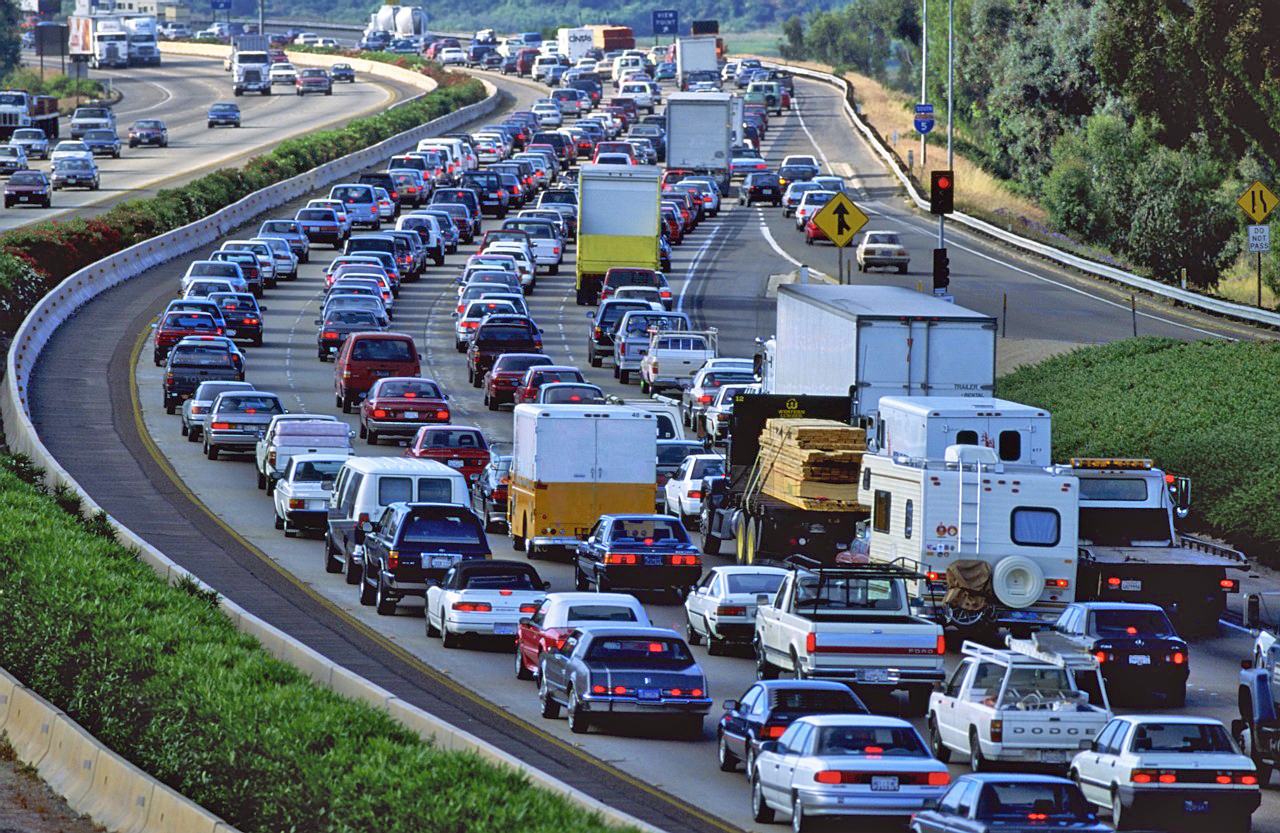
Today, I did something I don’t plan to do for a long time. I maneuvered through morning rush-hour traffic in an attempt to keep my word that I’d attend an early-morning event. I won’t be making that mistake anytime soon, but there was a light-bulb moment for me in battling drivers cutting me off, slick roads, brake-riding drivers, barreling-down-the-freeway-outta-control tractor-trailer drivers and raindrops that kept falling on my windshield. And in that moment I realized something significant: This country is mad! M-A-D-MAD! Yeah, that mad. The kind that gets people committed.
But how do you commit the majority of a country? A majority that can’t see that they’re suffering from mental imbalances? A feeling rushed over me, as I tried my best to drive at a leisurely, safe pace and not, on this rainy day, end up occupying the same space at the same time with another vehicle; it was a feeling of roboticism.
Think about it.
Hundreds of cars, trucks and tractor-trailers in seas of blues, blacks, reds, whites, yellows, burgundys, greens and beiges stacked bumper-to-bumper as far as the eye can see. And when you’re at the top of I-285 heading west, you can see pretty far, especially if you’re wearing your glasses. But it’s not so much how backed up the cars are or the color of the vehicles, it’s the realization that they’re, for the most part, obediently following the guidelines of driving and getting to work that have been prescribed by those who make the laws. Those who hold the power. Those who do not take the same drive because they don’t have to.
So, every morning, mostly Monday through Friday, these same drivers, who feel they must, conduct the same drive at the same time in hopes of arriving to work at the same time every day to do the same task with the idea that they’ll depart at the same time only to rinse and repeat the next day. And they do it robotically. Sometimes angrily, sometimes while chatting on the phone, sometimes with fingers snapping to the music or heads nodding to the talk shows but, all the same, they do it in robotic fashion, many not remembering how they even got to work unless, of course, they’re rear-ended, rear-end someone or are pulled over to be ticketed.
What would create such a sense of complacency in what can be considered by all estimates an extremely large group of people? We’re talking about millions here. And this isn’t just occurring in my city. It’s happening around the country. Places like Los Angeles could offer us a telling case study in this phenomenon called rush hour and its relationship to roboticism. I’ve heard of people sitting on the 405 for hours—and when I say hours, anybody from that area code can back me on what is meant by hours in “405 time.”
I can only identify such behavior as odd, robotic and conformist. It’s nothing short of hypnotic. The question is, how and when did we arrive on the doorsteps of this roboticism? Further, who were the players in bringing such a startling, yet magnificently orchestrated event to fruition? Most importantly, why and what did they expect to gain by roboticizing a nation?
Many answers come to mind. Some that would be seen as plausible; others as nothing more than theoretical. But the fact remains that the people in this country have changed drastically. In a country where chaos reigns supreme, people fall in line to obey the rules. Following the rules has become synonymous with not having to think much about anything, just simply do what you’re told you’re supposed to be doing and everything should be fine. There’ll always be the oddity, but it’s expected that the majority will obey the rules and can be counted upon to assist in the persecution of anybody who dares to be different by challenging authority or questioning the rules.
Anytime I reflect on this country and the behind-the-scenes mechanisms and shenanigans, I can’t get past one absolute—and that is the corruptness of this country and those who have placed themselves in leadership over it. A rule of thumb when determining the corruptness of a country is to observe how the purported laws are interpreted and applied. In America, you know the law of the land is corrupt, in itself, when you’re told that you’re being tried by a jury of your peers, yet you don’t know a damn soul sitting in the jury box.
To go back to the original point, how do we account for the growing roboticism? What is the root cause? Are there variable causes? When will this roboticism reach the boiling point? Who’ll be left standing when it does?
Getting to the root of the epidemic of roboticism requires knowing what all robots have in common. It is there we’ll be able to begin to piece together the million-piece puzzle so that we don’t fall into a routine of complacency and roboticism where we conduct the same drive to the same place at the same time every day to perform the same tasks with the idea that we’ll depart at the same time only to rinse and repeat the next day.
Leave a Reply